 SRE as a Service
 DevOps as a Service
 DevOps insurance
 Private, self-hosted LLM
 Infrastructure & CI/CD audit
 Kubernetes and cloud migration
 R&D and technology consulting
 Kubernetes support
 Solution for SaaS
 Migration from Vercel
 All services
 DevOps and SRE as a Service comparison

The Kubernetes v1.38 release is scheduled for December 16th and, as always, it comes with plenty of new features. They include security profile distribution via OCI artifacts, two-phase eviction, DRA-aware preemption, dynamic containers, per-container ulimits, weighted load balancing for kube-apiserver, and conditional authorization, among other things. Let’s take a closer look at 27 newly introduced enhancements!
Note: We do our best to announce the actual changes. However, given the ever-changing nature of the Kubernetes feature landscape, some of the Kubernetes Enhancement Proposals (KEPs) discussed in this article may be removed from the milestone as the release date approaches.
Nodes
Add Topology Manager option to improve workload density for single-numa-node
For performance-sensitive workloads like NFV and AI/ML, keeping allocated CPUs, memory, and devices (such as GPUs) on the same NUMA node is essential. In Kubernetes, the Topology Manager takes care of this. It coordinates resource providers (CPUManager, MemoryManager, DeviceManager), gathers their TopologyHints, and applies the alignment policies (single-numa-node, restricted, best-effort).
Previously, if multiple placement options were available for a Pod (say, adequate resources on both NUMA 0 and NUMA 1), the Topology Manager did not account for the existing resource allocation levels on those NUMA nodes. Instead, it defaulted to a tie-breaker favoring the NUMA node with the lowest ID — typically NUMA 0. As a result, workloads piled up on some NUMA nodes while others sat idle.
KEP-6007 adds a new numa-allocation-strategy option to the Topology Manager. It lets you control how an eligible NUMA node is picked depending on their resource allocation levels. It supports three values: none (default), most-allocated (consolidates workloads), and least-allocated (spreads workloads across NUMA nodes).
The TopologyHint struct gets a new score field to measure resource allocation. It is calculated based on allocated CPUs, memory, and devices rather than their actual utilization. The score only acts as an additional criterion to choose between equally valid hints and doesn’t change any existing topology guarantees. On top of that, you can adjust the weights for specific resources or exclude them from scoring altogether.
Enable Writable cgroups for unprivileged containers
To limit container resources (CPU and RAM), the Linux operating system uses the cgroups (control groups) mechanism. The configurations for these limits are stored in the container’s /sys/fs/cgroup directory. Kubernetes mounts this directory as read-only by default to prevent a program inside the container from changing its own limits or interfering with other apps on the same node.
However, there are some use cases where you actually need to spin up child cgroups right inside the container. For example, they include nested containers such as Docker-in-Docker (DinD) and applications that dynamically manage resources.
KEP-5474 adds a new cgroupOptions field under securityContext in the Pod manifest:
apiVersion: v1
kind: Pod
metadata:
  name: writable-cgroups-example
spec:
  containers:
  - name: app
    image: myapp:latest
    securityContext:
      cgroupOptions:
        mountMode: Writable
When its mountMode is set to Writable, the container runtime (like containerd or CRI-O) will mount the /sys/fs/cgroup directory inside the container as writable. In this scenario, the container will be able to create subgroups and allocate resources within its own cgroup subtree; however, it cannot exceed the overall limits established for the Pod. The system will respond to any breach of the aggregate Pod limits in the standard manner — for example, killing the process with an OOM error.
Allow specifying whether to unshare cgroup namespaces
In cgroup v2, privileged Pods share the host’s cgroup namespace by default. If you run nested containers inside them, their processes may end up outside the Pod’s cgroup hierarchy, messing up resource accounting and limit enforcement. This can result in OOM events and CPU contention on the node.
KEP-5714 lets you explicitly enable cgroup namespace isolation for such Pods.
OCI Artifact-Based Security Profile Distribution
Kubernetes uses seccomp profiles (to restrict syscalls) and AppArmor profiles (to restrict file, path, and network access, among other things) for isolating Linux containers. The pain point is distributing custom Localhost profiles: you have to get the profile onto the node before a Pod can apply it.
Currently, three approaches are commonly used to push profiles onto nodes:
- Baking them into node images. The downside is that to update a profile, you have to rebuild the images and roll out all your nodes.
- A dedicated DaemonSet. This approach is prone to race conditions: a workload may be scheduled and started before the DaemonSet has delivered the profile to a specific node.
- Security Profiles Operator. It gets rid of the distribution issue; the downside is that you have to deploy a whole operator with all those CRDs, RBAC, and webhooks just for that.
And here goes the magic: KEP-6061 suggests shipping security profiles as OCI artifacts! In alpha, seccomp is supported, with AppArmor support planned for beta. The PodSpec specifies a full, digest-pinned OCI reference (registry/repository@sha256:...); mutable tags are intentionally unsupported. kubelet retrieves registry credentials via imagePullSecrets and hands them to the CRI runtime, which then pulls the profile and caches it.
Note that the OCI profile isn’t applied “as is”. Instead, the runtime logically intersects the runtime’s baseline profile with an optional base profile specified in the PodSpec and the OCI profile. This way, an OCI profile can only add up to restrictions and cannot weaken the node-level protections configured by an administrator. Here’s an example:
securityContext:
  seccompProfile:
    type: OCI
    oci:
      reference: "registry.example.com/agents/code-exec-seccomp@sha256:9d4e..."
      baseProfile:
        type: Localhost
        localhostProfile: "agentic-baseline.json"
For AI agents, an admin can distribute a base Localhost profile across nodes. Each agent type then points to its own OCI profile. The runtime computes the logical intersection of these two profiles along with its own baseline profile; thus, if you tighten the baseline profile, the new restrictions automatically apply to every agent using it — no need to republish any OCI profiles.
Support hugepages in kubelet’s --system-reserved and --kube-reserved flags
- KEP #6252 (issue)
- Feature gate: none (to use this new behavior, administrators need to manually specify
hugepages-<size>in the--system-reservedand--kube-reservedflags; otherwise, everything works just as before)
Kubernetes Pods can eat up all the available resources on a node. That is an issue because system daemons and system components such as systemd, sshd, kubelet, containerd, etc., are running on those nodes, too. The Node Allocatable mechanism lets you subtract the resources needed by those daemons and components from node.status.allocatable.
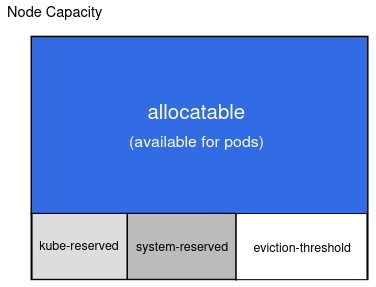
This way, Pods won’t be able to eat them all up. Previously, kubelet’s --system-reserved and --kube-reserved flags supported only four resource types: cpu, memory, ephemeral-storage, and pid. There was no reservation mechanism for hugepages, which meant a Pod could end up on a node with insufficient hugepages.
KEP-6252 extends --system-reserved and --kube-reserved to support hugepages-<size> resources. Administrators can now configure hugepages reservations at the node level (and even break them down by NUMA node), for example:
--system-reserved=hugepages-2Mi=512Mi
--reserved-memory 0:hugepages-2Mi=256Mi --reserved-memory 1:hugepages-2Mi=256Mi
Keep in mind, however, that the hugepages pool still needs to be pre-allocated on the host; kubelet doesn’t create hugepages on its own.
Support In place update pod resources alongside static cpu manager policy
Kubernetes allows changing CPU and memory limits for running Pods “on the fly” (see KEP-1287), but this feature used to conflict with the Static CPU Manager Policy. Since this policy strictly pins specific physical CPU cores to containers to cut down latency, changing the number of physical cores for a running process without fully restarting it just wasn’t technically possible before KEP-5554.
The new feature allows dynamically changing the number of CPU cores for running Guaranteed QoS Pods without restarting them. When CPU limits are increased, the kubelet allocates additional physical cores to the application, trying to place them on the same NUMA node to maintain memory locality. When you lower the limits, the unneeded cores are freed up and released back into the node’s shared pool.
Per-container ulimits configuration
Linux uses ulimits to restrict running processes, such as limiting how many files they can open or how much memory they can lock. Containers inherit these limits from the container runtime, which pulls them directly from the node or systemd configuration.
Some applications, especially databases like Elasticsearch, require higher limits for open files or processes than what the runtime provides by default.
KEP-5758 introduces a new ulimits field to a container’s SecurityContext. kubelet will read the specified values and pass them to the container runtime via the updated CRI API (LinuxContainerSecurityContext), which will then apply them to the running process.
Only allowlisted parameters will be accepted:
nofile(max open files). It has a hard API cap of 1,048,576. If you set it higher, the Pod simply won’t be created;memlock(locked memory);core(core dump size);niceandrtprio(scheduling priorities);stack(stack size).
Keep in mind that only Privileged Pods can use ulimits, and Windows containers don’t have ulimits.
Dynamic Pod Mutation: Optimistic Execution & Hierarchical Resource Delegation
Historically, the spec.containers field in a Pod manifest has been immutable: you could not add containers to or remove them from a running Pod.
In latency-sensitive setups where containers are spun up all the time (such as AI, agentic workloads, warm pools), the ability to start new containers or terminate old ones within a running Pod would be very useful.
KEP-5972 addresses this limitation by introducing support for dynamic containers at the Pod specification level. The new mechanism lets you add regular containers to or remove them from a running and initialized Pod via a pods/dynamic subresource. It also validates authorization permissions, admission policies, and resource availability; if there aren’t enough resources, the container will not be started. The states of added and removed containers are reflected in the Pod status.
Configuration for Per-Pod PID Limit
- KEP #6063 (issue)
- Feature gate:
PerPodPIDLimit(depends onPodLevelResources, which is in Beta and enabled by default since K8s v1.34)
Previously, the PID limit in Kubernetes could only be configured using the podPidsLimit parameter, which was applied globally to the entire node. This created a classic dilemma: keeping the limit low protected against software failures or malicious code, but caused issues for system apps like Istio or AI agents. Conversely, a high limit meant one unstable Pod could consume all available PIDs and bring down the node.
With KEP-6063, you can now set PID limits per Pod, i.e. the exact number of processes a Pod is allowed to run right in its specification (spec.resources.limits.pids).
If both parameters (podPidsLimit and spec.resources.limits.pids) are set, kubelet will apply the smaller value to the Pod. This means you still can’t exceed the limit enforced at the node level. The feature requires cgroups v2; requests.pids is not supported.
Workload Controlled Swap
Prior to this KEP, Kubernetes supported node-level swap (see KEP-2400). The issue was that in LimitedSwap mode, the swap allocation was calculated implicitly; Pods themselves could not control the amount of swap space they consumed, and kube-scheduler had no awareness of a node’s swap capacity or how swap was distributed across Pods.
KEP-5359 extends the Kubernetes API so that Pods and containers can now explicitly control their swap limits. To do so, a new WorkloadControlledSwap mode is introduced for memorySwap.swapBehavior. In this mode, swap usage is no longer calculated automatically anymore like in LimitedSwap mode; instead, you configure it per container and/or Pod. Note, however, that requests.swap isn’t supported.
You set swap limits via resources.limits.swap — either per container (containers[*].resources.limits.swap) or for the entire Pod (check the example below).
How to set swap limits at the Pod level? Here’s an illustrative example. If pod.spec.resources.limits.swap is explicitly set, containers that don’t specify their own limits.swap, i.e. c3-helper-a and c4-helper-b, share the Pod’s common swap budget (memory.swap.max = 2 Gi). Still, containers can set their own limits, e.g., c1-latency-sensitive turns swap off (swap: "0"), while c2-swap-worker’s swap is capped at 512Mi:
apiVersion: v1
kind: Pod
metadata:
  name: pod-level-swap-mixed
spec:
  resources:
    requests:
      memory: "4Gi"
    limits:
      memory: "8Gi"
      swap: "2Gi"
  containers:
  - name: c1-latency-sensitive
    image: cache:latest
    resources:
      requests:
        memory: "1Gi"
      limits:
        memory: "1Gi"
        swap: "0"
  - name: c2-swap-worker
    image: worker:latest
    resources:
      requests:
        memory: "1Gi"
      limits:
        memory: "2Gi"
        swap: "512Mi"
  - name: c3-helper-a
    image: helper:latest
  - name: c4-helper-b
    image: helper:latest
EvictionRequest API
Currently, PodDisruptionBudget (PDB) is the main mechanism for managing Pod evictions. However, it overlooks several edge cases:
- If a PDB is set up to prevent downtime for a single-replica app, running
kubectl drainwill simply get stuck. - To migrate a Pod without downtime, you have to manually adjust configurations, deploy a new Pod, and only then remove the old one.
- The Descheduler doesn’t allow you to postpone application evictions. This leads to lost progress and wasted compute resources.
- Kubernetes lacks resource reservation functionality during Pod migration; ideally, the system should ensure the required workload resources are available prior to eviction.
- Different Pod termination mechanisms conflict with one another. For instance, the Taint Manager might prematurely terminate Pods that are actively undergoing a Graceful Shutdown process.
KEP-4563 divides the eviction process into two distinct phases: the eviction request and the actual eviction. It introduces the following new entities:
- EvictionRequest. This object can be generated by any component or user wishing to evict a Pod (such as an admin, Cluster Autoscaler, or Descheduler). It is essentially a declaration of intent. A single Pod can receive multiple requests, and their creators can cancel them.
- Eviction Request Controller. This new controller collects all EvictionRequests for a Pod and creates a single Eviction object. This ensures transparency: you can always see the exact status of a Pod’s eviction and who asked for it.
- Responders. Pods get a new
.spec.evictionRespondersfield where you can specify controllers or scripts responsible for gracefully deleting the Pod. A responder can provision a Pod on a different node and wait for its readiness prior to deleting the old one, perform data checkpointing before Pod termination (crucial for ML and Stateful workloads), migrate data off the node, or even reject the request if the Pod is currently executing a critical task, and much more.
If a Pod lacks responders, or if they fail to terminate the Pod or hang for any reason (a timeout/heartbeat mechanism is implemented to monitor their activity), Kubernetes will default to the established legacy method: API-initiated eviction (taking PDBs into account).
Here’s an example of a Pod manifest with the responders set up:
apiVersion: v1
kind: Pod
metadata:
  labels:
    app: nginx
  name: sensitive-app
  namespace: blueberry
  spec:
    ...
    evictionResponders:
      - name: horizontalpodautoscaler.autoscaling.k8s.io
      - name: sensitive-workload-operator.fruit-company.com
      - name: deployment.apps.k8s.io
      - name: replicaset.apps.k8s.io
      - name: fallback-responder.rescue-company.com
Scheduling
DRA: Shared Consumable Capacity
This KEP addresses the issue of distributing a single resource pool among multiple child devices. Previously, Kubernetes could either hard-partition resources into fixed chunks or dynamically assign them to isolated devices. The scheduler lacked the ability to track scenarios where multiple virtual devices dynamically consumed resources from a shared parent limit. As a result, administrators had to either manually chop up resources (which is inefficient) or deal with the risk of over-allocation.
Let’s look at an example. Suppose you have a network card featuring a total bandwidth of 100 Gbps, which you slice into virtual functions (VF) for Pods. One Pod requests a 10 Gbps VF, and another requests 20 Gbps.
- Before KEP-5941: The scheduler was unaware that these VFs shared the same 100 Gbps limit. It could allocate 10 Gbps to twenty different Pods, effectively exceeding the card’s physical capacity twofold — the classic over-allocation problem. To prevent this, cluster admins would just slice the shared pool into several fixed-bandwidth virtual devices, like 4×25 Gbps (the manual chop up problem). Because of this, a Pod needing 30 Gbps couldn’t get it, even if the network card was sitting idle.
- With KEP-5941: The scheduler will subtract the requested bandwidth (10 Gbps, 20 Gbps) from the total 100 Gbps capacity when placing a Pod, ensuring the limit is never exceeded.
DRA: preemption
KEP-5690 addresses a big gap in Dynamic Resource Allocation: the lack of preemption mechanism. Previously, when selecting candidate Pods for preemption, the scheduler could only look at basic parameters such as CPU and memory, since the dynamicresources plugin didn’t support preemption for DRA. DRA resources are defined by complex specs such as NVLink topology, GPU slices, etc., via ResourceSlice objects and CEL filters. So the scheduler failed to determine the outcome of its actions — namely, whether preempting a specific Pod would actually free up the required resources. As a result, high-priority Pods would end up stuck in Pending.
This KEP introduces native preemption support into the DRA mechanism. Now, the scheduler checks which Pods are using which claims, rules out any Pod which preemption would not free up the required resources, and simulates what device availability would look like if candidates are preempted (starting with the lowest-priority Pods).
Because of how DRA works, when a Pod is deleted, its ResourceClaim isn’t freed right away — the controller releases it after a short delay. To prevent other Pods from claiming those resources, they are temporarily reserved for the high-priority Pod via the claim nomination mechanism: the scheduler saves the simulated AllocationResult for the preemptor Pod and treats those resources as occupied.
DRA Extended Resource Capacity
Extended resources and device plugins let Kubernetes handle specialized hardware such as GPUs. They used a simple counter model: you could only have an integer amount of resource (e.g., nvidia.com/gpu: 4), and upon allocating it to a Pod, an integer multiple of one unit was subtracted from the total.
Over time, things got more complicated: e.g., administrators wanted to link GPUs over high-speed buses or partition them using time slicing. So the DRA mechanism was introduced. Instead of plain numbers, DRA uses datasets (ResourceSlice) to describe device resources, and you request those resources via ResourceClaims. KEP-5004 allowed you to use extended resources on top of DRA: the scheduler synthesized DRA requests for Pods using resources.requests. The catch was that you couldn’t specify how much capacity you wanted in that request, so the entire resource had to be consumed as a whole.
KEP-6406 solves this by letting users request extended resources in the usual fashion (through resources.requests) while leveraging DRA’s tools for resource partitioning and fractional allocation. Administrators can now define in a DeviceClass that one unit of an extended resource equals a specific GPU slice, NIC bandwidth, and so on. To make this work, an optional extendedResourceCapacityRequests field has been added to DeviceClassSpec.
The best part about KEP-6406 is that you can move existing workloads over to DRA without having to rewrite existing manifests. This KEP neither alters the DRA allocation algorithm, introduces a new API type, nor publishes DRA capacity to Node.status.capacity/allocatable; instead, it basically just forwards CapacityRequirements from DeviceClass into the existing DeviceRequest.Capacity field.
API
Add configurable etcd object compression for kube-apiserver storage
This KEP introduces a compression mechanism for objects stored in etcd. The kube-apiserver handles the compression, with serialized compressed prior to encryption. This is especially useful for clusters using encryption at rest, since encrypted data basically cannot be compressed, so etcd or its storage backend has no way to shrink its size.
Note that compression is not enabled globally for the entire etcd instance; rather, the administrator specifies the path to a configuration file via the --storage-compression-config flag (e.g., --storage-compression-config=/etc/kubernetes/storage-compression.yaml). This file (see the example below) contains rules specifying which types of Kubernetes resources to compress, the algorithm to use, and the minimum serialized object size to compress. The latter is set by the minSize parameter (1 KiB by default, as the storage gains for smaller objects don’t justify the CPU costs of compression/decompression).
A configuration example:
apiVersion: apiserver.config.k8s.io/v1alpha1
kind: StorageCompressionConfiguration
resources:
  # Ordered: the first entry matching a resource wins, exactly as in
  # EncryptionConfiguration. This is how a resource is excluded from a wildcard.
  - resources: ["events", "events.events.k8s.io"]
    algorithm: None
  - resources: ["customwidgets.example.com"]
    algorithm: Deflate
    # Optional per-entry write threshold. Defaults to 1Ki when omitted.
    minSize: 512
  - resources: ["*.*"]
    algorithm: Deflate
The first rule that matches a resource is applied. In the example above, events are excluded from the general wildcard rule resources: ["*.*"], and a custom threshold (minSize) of 512 bytes is configured for the customwidgets.example.com resource.
Secrets are automatically excluded from wildcard matches; an administrator must explicitly enable compression for them. This is a safety feature to prevent attackers from guessing its content based on how well the data compresses. Basically, the resulting size of a compressed object can indirectly reveal information about its payload. When compression for Secrets is explicitly enabled, kube-apiserver fires up a warning at startup.
Stall and resume slow watch streams instead of terminating them
In kube-apiserver, watch cache pushes events to watchers through a bounded input channel. Things go south when this channel overflows. The existing code cannot distinguish the following two cases apart:
- The client is truly frozen.
- The client is OK but temporarily lagging behind (e.g., it has just reconnected and needs to catch up on missed history).
Currently, kube-apiserver handles both cases the exact same way: it temporarily blocks the main event delivery path, hoping the channel will free up. If it doesn’t, it just kills the watch, marking it unresponsive.
Such an approach triggers a chain reaction: one “stuck” watcher slows down all others. The disconnected client immediately retries the watch (there is no backoff mechanism), the lag grows, the buffer fills up even faster, and the server drops the connection again. This wastes a lot of resources on re-serializing objects while bypassing the cache. On top of that, short-lived internal delays in the kube-apiserver can also fill up the channels, causing perfectly healthy streams to get killed.
To fix this, the authors adopted the synced/unsynced mechanism from etcd. Now, if a watcher’s input channel is full, the server no longer waits for it to clear (which would block delivery for others); instead, it marks the watcher unsynced. Those unsynced watchers then read the missed events straight from the in-memory watch cache history. Once they catch up, the server automatically plugs them back into the live stream using the same connection.
The only reason to terminate a lagging watch is if the required events are no longer in the history. When that happens, the server delivers whatever backlog is left, sends a 410 Gone (Expired) error in the stream, and forces the client to restart the watch/do a relist.
Weighted Load Balancing for kube-apiserver
- KEP #6315 (issue)
- Feature gate:
RequestCostAggregation(and the--enable-endpoint-load-metricsflag)
Currently in HA clusters, load balancers route traffic to kube-apiserver replicas using unweighted algorithms (like round robin or random distribution), completely unaware of the actual load on those replicas. Because leader-elected controllers with informers/watch streams tend to stick to one replica and put a heavy load on it, it creates a “hot node” effect. This results in latency spikes and makes API Priority and Fairness mechanism to drop requests and return HTTP 429 errors. In the worst case, the replica can just go down.
KEP-6315 introduces support for weighted load balancing in kube-apiserver based on the Open Request Cost Aggregation (ORCA) standard. When this feature is enabled, kube-apiserver will attach info about current load — specifically, CPU usage and the number of in-flight requests — to its responses.
An ORCA-compatible L7 load balancer can use this data in Weighted Round Robin (WRR) or Weighted Least Request (WLR) algorithms to manage traffic by dynamically reducing the weight of heavily loaded replicas. All new unary requests (GET, LIST, POST, PATCH, DELETE from the kubelet, CI/CD pipelines, and users) will be redirected to less busy replicas.
Since kube-apiserver interacts with untrusted and even anonymous clients (such as on /readyz), attackers could use the replica load information to run DoS attacks or monitor other tenants’ activity. The KEP introduces several safeguards to prevent this: the feature is off by default; a new header (endpoint-load-metrics-request) is required for the requests; the load balancer must strip the metrics headers from the responses before forwarding them to clients.
API Server Write Throughput: Address Allocation Ceiling and Degraded State Bottlenecks
- KEP #6404 (issue)
- Feature gate:
ConsistentGetFromCache(enabled by default since the KEP is being released as Beta right away)
When applying a small patch to a 10 KB Pod object, kube-apiserver can consume more than 1 MB of memory. The main offenders here are managedFields and Server-Side Apply overhead (responsible for over half of all allocations), as well as having to serialize/deserialize the entire object all over again for just a few changed bytes.
Things get worse during traffic spikes or brief glitches: they trigger fallback paths that basically double the allocations. Specifically, dropped watch connections invalidate the serialization cache, while optimistic transaction (TXN) conflicts force kube-apiserver to query etcd, fetch the latest object version, and decode it from scratch.
KEP-6404 reduces this overhead by routing GET requests through the watch cache. Those include consistent GET requests (resourceVersion="") and internal GETs triggered by GuaranteedUpdate conflicts.
Controller Leader Election Recovery
Kubernetes can run multiple controller manager replicas simultaneously, but only one of them — the leader — is permitted to make changes to the cluster. A Lease-based leader election mechanism prevents them from competing with one another: whichever replica manages to acquire the lock on the Lease, subsequently renews it on a regular basis.
During a short kube-apiserver or etcd outage, the leader might fail to renew its Lease before RenewDeadline (usually 10 seconds) expires. Right now, the controller manager terminates immediately so it doesn’t accidentally write anything to the cluster if another replica becomes the leader. The problem is that a brief glitch turns into an expensive recovery: the controller manager has to do a cold start and re-fetch huge amounts of data to warm up its caches.
Instead of killing the process, KEP-6361 proposes keeping it alive while cutting off its write access to the cluster. To achieve this, a Write Gate is introduced at the network request layer. Only read-only HTTP methods (GET, HEAD, OPTIONS, TRACE) are allowed to pass through. All other methods (POST, PUT, PATCH, etc.) are rejected with an ErrWriteGateClosed error.
Meanwhile, the election loop isn’t blocked and keeps trying to renew the Lease. At this point, there are four possible outcomes:
- If the leader manages to renew the Lease, the Write Gate opens back up and work continues with the existing warm caches.
- If another replica becomes the leader,
OnNewLeaderreports the new leader’s identity (standard behavior) and the elector exits. - The recovery deadline expires: the elector stops retrying and exits (standard behavior, the wait is just a bit longer).
- The context is canceled:
Runreturns (standard behavior).
Apps
WAS: Integrate Workload APIs with Deployment controller
The Kubernetes Deployment object was originally built for stateless services with independent Pods, which could work just fine if not all pods come up right away. Recently, however, the nature of workloads has shifted: Kubernetes clusters are increasingly running workloads such as AI/ML. These need some unique scheduling tricks:
- Gang scheduling: By default, all replicas must start simultaneously (unless you set a custom number in
minCount). - Topology-aware scheduling: To minimize latency, all replicas need to end up in the same topology domain.
So the developers introduced Workload-Aware Scheduling, adding API objects such as Workload and PodGroup. The catch is that Deployment doesn’t support them natively yet.
KEP-6276 resolves this by borrowing the integration pattern designed for Job (KEP-5547). The Deployment gets a new spec.scheduling field to define the scheduling policy, topology constraints, preemption behavior when resources are tight, and DRA resources shared across the whole group.
Add more granular failure reason for Job PodFailurePolicy
A Kubernetes Job handles Pod failures using the PodFailurePolicy mechanism, which allows specifying a list of rules. For example, if a container exits with a specific exit code, a rule can immediately fail the entire Job (action: FailJob).
Higher-level Kubernetes primitives are frequently built on top of lower-level ones. For example, JobSet manages a group of related Job resources and often needs to determine why a particular Job failed. The issue is that whenever a Job fails, its status is populated with the exact same reason: PodFailurePolicy value, no matter what caused the error.
KEP-4443 adds a name field to the PodFailurePolicyRule struct. This enables setting the reason field to the name of the rule that caused the Job to fail. If rule names are not specified, the rule’s index will be used instead.
Storage
Dynamic node-local ephemeral volumes
Once a Pod is scheduled to a node, its storage configuration is locked in: you cannot add a new volume to pod.Spec.Volumes or change a container’s volumeMounts. That worked fine for classic stateless services in the past, but for modern workloads, it’s turned into a bottleneck.
KEP-6395 lets you dynamically add and remove node-local ephemeral volumes (configMap, secret, projected, emptyDir, and image) on running Pods through a /dynamic subresource. In alpha, there is no hot-mounting: volumes are only updated when an existing container restarts (you need to explicitly set dynamicVolumePolicy.restartPolicy: RestartContainer in the spec), a new container is added, or a container is removed. The alpha version doesn’t make any changes to the Container Runtime Interface, the scheduler, or cluster-level volume controllers (AttachDetachController/PVController), while PVC and hostPath aren’t supported yet either.
CSI ControllerGetNodeInfo
When a new node is added to a cluster, the CSI driver registers its details — including node ID, topology, and how many volumes can be attached to it. Currently, the node plugin collects this data via the NodeGetInfo RPC. To find out the domain and volume limits, it has to query the cloud provider’s API, meaning credentials have to be placed on the nodes. This creates security and scaling risks (e.g., all nodes query the provider API at the same time when spinning up large clusters), among other things.
KEP-6011 splits this process into two steps. The node plugin now only returns the name/ID (it can fetch them locally), while the controller (since it already has cloud API access) collects the rest of the data. A new ControllerGetNodeInfo RPC is introduced to handle this. This way, you no longer need to store credentials on nodes, while requests to the provider API can be easily cached or batched.
CSI global mount fallback for volume reconstruction
KEP-6058 fixes a critical bug where a volume remains mounted on a node after a kubelet restart or node reboot, while no longer being reported in node.status.volumesInUse. As a result, the attach/detach controller assumes the volume is free and lets another node attach it — leading to concurrent writes from two nodes and data corruption.
The problem boils down to the fact that at startup, the volume reconstruction process only scans Pod directories in /var/lib/kubelet/pods. Because of this, global mounts can get “lost” during a node drain followed by a reboot (when the pod is already deleted, but NodeUnstageVolume didn’t finish in time), or if the local vol_data.json file in the Pod directory gets corrupted or deleted.
For the first scenario, the specVolID and volumeLifecycleMode fields are added to the global vol_data.json file (which is created on MountDevice). A new kubelet plugin interface, GlobalVolumeListerPlugin, lets the reconstruction process query the CSI plugin directly for all active global mounts (both filesystem and raw block) before scanning pods. Any “orphaned” volumes found are recorded in ActualStateOfWorld as uncertain. This puts them back into node.status.volumesInUse (preventing concurrent attachments) and gives the reconciler a chance to properly finish NodeUnstageVolume and clean up the disk.
For the second scenario (the Pod directory is there, but the local vol_data.json is unreadable), a fallback is added to ConstructVolumeSpec and NewUnmounter methods: if reading the local file fails, the kubelet checks the mount table to find the bind mount linked to the corresponding global mount and pulls the metadata from there. This fallback survives a kubelet restart, though not a full node reboot, since the mount table gets wiped.
Auth
Conditional Authorization
In Kubernetes, the permission validation process is divided into two stages:
- Authorization: the authorizer only sees system metadata (who is making the request, to which API resource, and in which namespace). It does not see the object payload itself.
- Admission control: the controller sees the entire object payload (fields, labels) and validates or mutates it before executing the operation or saving changes.
This approach is inconvenient. For instance, to allow a user to create PersistentVolumes (PV) with the dev storage class (i.e., storageClassName == "dev"), one must:
- Grant them permission to create any PVs in RBAC.
- Add a rule to the admission controller to reject all attempts by the user to create a PV if the storageClassName is not dev.
Essentially, we initially grant excessive permissions and then restrict them using an admission controller. On top of that, if the user runs kubectl auth can-i create pv, the system replies “Yes”. But the moment they try to create a prod PV, it’ll fail with a confusing error message.
KEP-5681 introduces conditional authorization to Kubernetes. At authorization time, an authorizer evaluates the request metadata (user, verb, API group, resource, namespace, name) and the object’s actual data (like fields and labels) and it can return Allow, Deny, NoOpinion, or Conditional. The key point is that the authorizer still doesn’t read the object at the auth stage. Instead, it issues a new Conditional status featuring a residual condition to be evaluated later.
Now, when a request comes in, the authorizer evaluates the metadata it has (like verifying the user’s identity and checking they can create PVs). Because the storageClassName isn’t known yet, it returns a Conditional status, attaching the condition: object.spec.storageClassName == "dev".
The request moves forward, and during the admission check, a new built-in plugin called AuthorizationConditionsEnforcer verifies the conditions against the actual object data. It then decides to Allow, Deny, or return NoOpinion, after which Kubernetes applies its usual rules for combining authorizer decisions.
Leveraging certificate APIs in the platform
In Kubernetes 1.37, two APIs for managing X.509 certificates graduated to stable: ClusterTrustBundle (for publishing and selecting trusted CA certificate bundles; KEP-3257) and PodCertificates (for issuing certificates to Pods; KEP-4317). The problem was that Kubernetes had no built-in mechanism to use those APIs directly.
KEP-6283 brings support for those new features right into Kubernetes.
Network
Network Isolated Pods
Historically, Kubernetes assumes that every regular Pod gets its own network namespace, connects to a flat cluster network and is assigned an IP address — unless hostNetwork: true is set. Nowadays, however, this behavior is suboptimal for a wide range of workloads that do not need standard K8s networking, such as AI/ML workers (those get their network via DRA drivers) or isolated sandboxes for AI agents.
An earlier attempt to fix this by introducing full-fledged Multi-Network support failed due to excessive complexity. So the developers took a more radical approach: allowing Pods to bypass the default cluster network completely. An optional podNetwork field is added to PodSpec, featuring two options:
Default— the usual behavior: the Pod gets its own network namespace and connects to the cluster network.Isolated— the Pod gets an isolated network namespace with a loopback interface only.
If podNetwork isn’t set, the Pod falls back to the Default behavior. Obviously, you cannot specify podNetwork for Pods running with hostNetwork: true. An isolated Pod doesn’t get a podIP, isn’t included in Endpoints/EndpointSlices, and cannot use hostPort or network HTTP/TCP/gRPC probes.
Non-alpha v1.38 release highlights
As always, our article focuses on the new alpha (and one beta) features in Kubernetes v1.38. At the same time, this release also includes many other updates. At least, we’ll mention some of them, as selected by Dmitry Shurupov, our co-founder and a CNCF Ambassador:
- Pod-level resources (KEP-2837), allowing us to specify resource requests and limits for each container, are now stable.
- kuberc (KEP-3104), an optional configuration file for kubectl user preferences, is also becoming stable.
- Workload-aware preemption (KEP-5710), introduced in Kubernetes 1.36 to treat groups of related Pods (PodGroups) as a single entity for scheduling and preemption, is moving to Beta and merging its
PodGroupPreemptionPolicyinto theGenericWorkloadfeature gate. - Container stop signals (KEP-4960), which allow defining custom signals used to kill the container, are moving to Beta and enabled by default.
- Default Pod Sysctls in the kubelet configuration (KEP-5996) are also in Beta and enabled by default.
Still, it’s not the complete list of changes introduced in Kubernetes v1.38. For the most comprehensive information, please follow the official enhancements tracker and changelog.
P.S.
At the end, we’d like to thank all the Kubernetes contributors for another great release! If you’re interested in other alpha features recently added to K8s, check out our previous deep dives:
- Kubernetes v1.37 (August 2026);
- Kubernetes v1.36 (April 2026);
- Kubernetes v1.35 (December 2025);
- Kubernetes v1.34 (August 2025).

Comments